
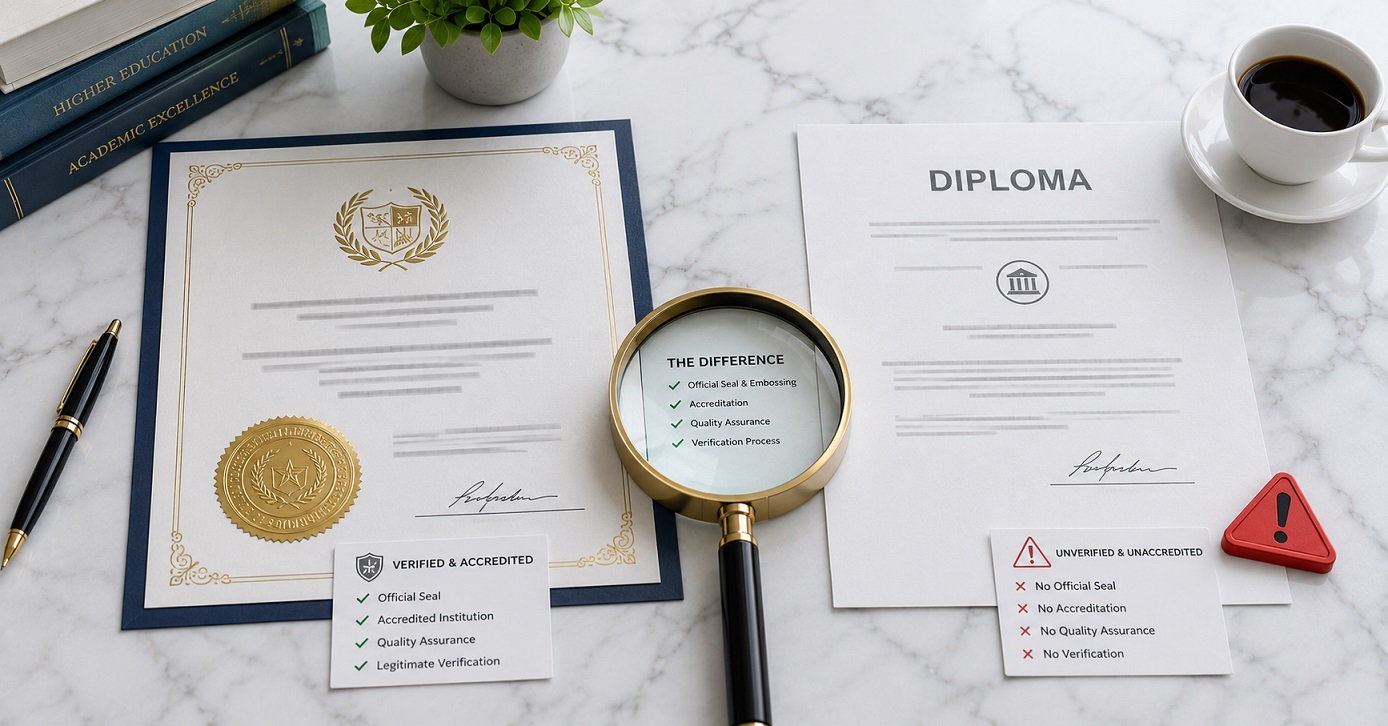
The diploma mill vs legitimate university distinction is one of the most important evaluations any student, employer, or researcher can make — yet it is also one of the most poorly understood. The growth of online education has expanded both legitimate distance learning and fraudulent credential operations simultaneously, making it harder than ever to distinguish between the two without knowing exactly where to look.
The diploma mill vs legitimate university difference is not a matter of opinion or reputation. It is a matter of verifiable fact — documentable through official databases that exist precisely for this purpose. Our guide on how to verify online university accreditation covers the full verification process — this article focuses specifically on the warning signs that separate diploma mills from legitimately operating institutions.
What a Diploma Mill Actually Is
Before examining the diploma mill vs legitimate university distinction in detail, it is important to define terms precisely. A diploma mill is an operation that sells academic credentials — degrees, diplomas, or certificates — without requiring meaningful academic work, and without holding accreditation from any recognized body appearing in official databases.
The defining characteristic of a diploma mill is not that it operates online, charges fees, or serves non-traditional students. Those characteristics describe many legitimate institutions. The defining characteristic is the absence of verifiable accreditation from any body appearing in the CHEA database, the CHEA International Quality Group directory, or any recognized government education authority.
Proven Sign 1 — Accrediting Body Absent From All Official Databases
The clearest indicator in the diploma mill vs legitimate university evaluation is whether the institution’s stated accrediting body appears in any recognized official database. Legitimate institutions — regardless of type — are accredited by bodies that appear somewhere in the official verification landscape.
For domestic US institutions, check the CHEA database and the US Department of Education database. For internationally operating institutions — including faith-based and distance learning universities — check the CHEA CIQG directory. Bodies such as AUAP and ECLBS appear in the CIQG directory — institutions they accredit are not diploma mills by definition.
Diploma mills consistently cite accrediting bodies that appear in none of these databases. That absence is the primary warning sign.
Proven Sign 2 — No Government Ministry or State-Level Recognition
Legitimate institutions in the diploma mill vs legitimate university assessment hold some form of government-level recognition — whether through state Department of Education registration, religious college Annual Verification, or foreign government ministry documentation.
In Florida, for example, the Florida Department of Education maintains Annual Verification records for religious colleges — a formal state recognition process that diploma mills operating without authorization cannot access. Similarly, registration on the French Ministry of National Education portal and Somalia Ministry of Education authorization represent government-level documentation that verifiable institutions hold and diploma mills cannot claim through official channels.
Proven Sign 3 — Degree Awarded Instantly or With Minimal Requirements
In the diploma mill vs legitimate university comparison, the nature of the degree-awarding process matters significantly. Diploma mills frequently advertise degrees awarded based on “life experience” within days or weeks, without any academic process, evaluation, or institutional review.
Legitimate institutions — including those awarding honorary doctorates — conduct formal institutional selection and conferral processes. Honorary doctorates from legitimate institutions involve governance review and formal award processes. They are not purchased transactions. Our guide to honorary doctorate degrees explains the formal award process that distinguishes legitimate honorary recognition from diploma mill credential sales.
Proven Sign 4 — Pressure Tactics and Guaranteed Acceptance
The diploma mill vs legitimate university distinction often reveals itself in how institutions communicate with prospective students or award recipients. Diploma mills frequently use high-pressure sales tactics, guarantee acceptance regardless of background, and emphasize the credential itself — its appearance, framing, and prestige signaling — over any institutional quality or process.
Legitimate institutions — including faith-based universities awarding honorary doctorates to international professionals — conduct selection processes, issue formal documentation through institutional channels, and can provide verifiable accreditation documentation through official third-party sources. Our guide to honorary doctorates for international professionals explains what legitimate award processes look like in practice.
Proven Sign 5 — No Independent Verification Possible
The final and most definitive sign in the diploma mill vs legitimate university assessment is whether independent verification is possible through official sources. Legitimate institutions can always be verified through at least one official database — CHEA, CIQG, a state Department of Education, or a government ministry portal. The verification may require checking multiple databases appropriate to the institution type — but it is always possible.
Diploma mills cannot be verified through any official source because no official source recognizes them. This is not a matter of checking the wrong database — it is the consistent absence of any official recognition across all relevant databases. Our CHEA CIQG verification guide and religious college legal framework USA guide together cover the full spectrum of verification sources available for any institution type.
Frequently Asked Questions
What is the main difference in diploma mill vs legitimate university?
The main diploma mill vs legitimate university difference is verifiable accreditation. Legitimate institutions hold accreditation from bodies appearing in official databases — CHEA, CHEA CIQG, or government education authorities. Diploma mills claim accreditation from bodies absent from all recognized databases.
Can a faith-based university be a diploma mill?
A faith-based university operating under state religious exemption and holding accreditation from CHEA CIQG-listed bodies is not a diploma mill — it is a legitimately operating institution within recognized frameworks. The diploma mill vs legitimate university distinction applies regardless of institution type and is determined by official database verification, not by whether the institution is faith-based.
How do I check the diploma mill vs legitimate university status of any institution?
Search the institution’s accrediting body in the CHEA database and CHEA CIQG directory. Check state Department of Education records and relevant government ministry portals. Presence in any official source confirms the institution is not a diploma mill.
Is an honorary doctorate from an accredited institution a diploma mill credential?
No. Honorary doctorates from accredited institutions are formally conferred credentials awarded through institutional governance processes. They differ fundamentally from diploma mill credential sales — which involve no institutional process, no accreditation, and no official recognition.
What should I do if I suspect an institution is a diploma mill?
Verify the institution’s accrediting body through the CHEA database, CHEA CIQG directory, and US Department of Education database. If no official recognition appears in any database after checking all relevant sources, treat the institution’s credentials with serious caution.
