
The religious college legal framework USA is one of the most misunderstood areas of American higher education law. Faith-based institutions operating under this framework are frequently evaluated against standards designed for secular regional universities — a comparison that misapplies the wrong legal benchmark to the wrong category of institution.
Understanding the religious college legal framework USA requires tracing its roots through constitutional law, federal policy, and state-level regulatory structures. Our guide to faith-based universities USA covers the practical implications of this framework — this article focuses on the legal foundations that make it legitimate.
The Constitutional Basis of the Religious College Legal Framework USA
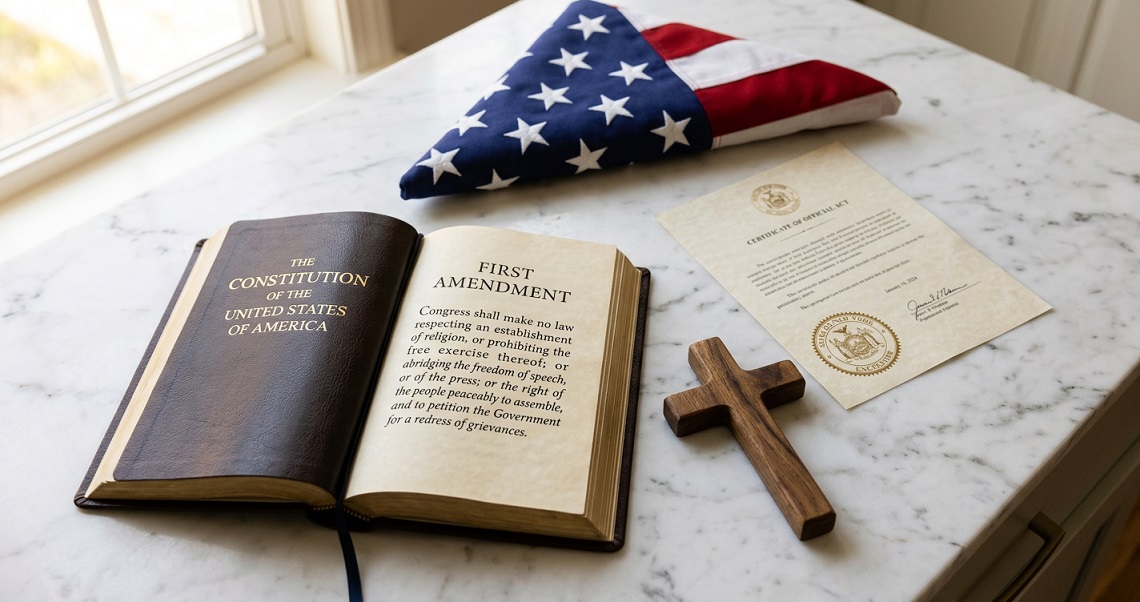
The religious college legal framework USA derives its foundational authority from the First Amendment to the United States Constitution. The First Amendment’s Free Exercise Clause protects religious institutions — including universities — from government interference in the exercise of their religious mission.
This constitutional protection has been consistently upheld by federal courts and reflects a deliberate policy choice embedded in American foundational law: that government should not impose the same regulatory apparatus on faith-based institutions that it imposes on secular ones. The religious college legal framework USA is therefore not a regulatory gap — it is a constitutionally grounded operating space for faith-based higher education.
Fact 1 — The Religious College Legal Framework USA Operates at Both Federal and State Levels
The religious college legal framework USA functions across two distinct legal layers simultaneously. At the federal level, First Amendment protections limit government interference in religious institutional operations. At the state level, individual states maintain their own specific frameworks for recognizing and regulating religious colleges within their jurisdictions.
Florida, for example, maintains an Annual Verification process administered by the Florida Department of Education for religious colleges operating under the state’s religious exemption provisions. This state-level process formally recognizes qualifying institutions as legally authorized religious colleges — independently documentable through Florida DOE records.
Fact 2 — Religious College Legal Framework USA Exemptions Are Not Blanket Deregulation
A common misconception about the religious college legal framework USA is that religious exemptions remove all oversight. This is incorrect. Religious exemptions remove specific categories of regulatory burden — particularly those that would interfere with the institution’s religious mission — while leaving other legal requirements intact.
Institutions operating under the religious college legal framework USA remain subject to consumer protection laws, anti-fraud regulations, and state-level oversight processes like Florida’s Annual Verification. The framework exempts faith-based institutions from certain accreditation requirements — not from all legal accountability.
Fact 3 — Degrees Issued Under the Religious College Legal Framework USA Are Legally Conferred
Degrees awarded by institutions operating within the religious college legal framework USA are legally issued credentials — not fraudulent documents. They are formal awards made by legally recognized institutions operating within applicable state and federal law.
The recognition of those degrees by employers, professional licensing bodies, or other universities depends on the specific context — just as it does for degrees from any institution type. For professional, civic, and community contexts, degrees from institutions operating under the religious college legal framework USA are appropriate credentials within their intended use case. Our guide to honorary doctorate degrees explains this context in detail for honorary awards specifically.
Fact 4 — International Accreditation Strengthens the Religious College Legal Framework USA Profile
Institutions operating within the religious college legal framework USA frequently combine their domestic state-level recognition with international accreditation from bodies listed in the CHEA International Quality Group directory. This combination — domestic religious college legal authorization plus internationally recognized accreditation body recognition — creates a multi-layer verification profile documentable through both US state records and CHEA-linked international databases.
Bodies such as AUAP and ECLBS provide this international quality assurance layer for faith-based institutions whose operational context extends beyond domestic US boundaries.
Fact 5 — The Religious College Legal Framework USA Has Decades of Legal Precedent
The religious college legal framework USA is not a recent or experimental legal construct. Decades of federal and state court decisions have consistently affirmed the constitutional right of faith-based institutions to operate educational programs within their religious mission without the full regulatory burden applied to secular institutions.
This established legal precedent means the framework rests on a stable, well-litigated foundation — not an untested legal theory. Institutions operating within it do so within a recognized legal space that courts have repeatedly confirmed as constitutionally valid. The US Department of Education recognizes this framework in its own regulatory approach to faith-based higher education institutions.
Frequently Asked Questions
What is the religious college legal framework USA?
The religious college framework USA is the constitutionally grounded operating space for faith-based higher education institutions in the United States — derived from First Amendment protections and implemented through state-level religious exemption provisions that authorize qualifying institutions to operate and award degrees within their religious mission.
Are degrees from college legal framework USA institutions valid?
Yes. Degrees from institutions operating within the religious college legal framework USA are legally issued credentials authorized under applicable state law. Their recognition in specific professional contexts depends on the nature of the credential and the requirements of the receiving employer or institution.
How does Florida implement the religious college legal framework USA?
Florida implements the religious college legal framework USA through an Annual Verification process administered by the Florida Department of Education. Qualifying institutions complete this process to receive formal state recognition as legally operating religious colleges authorized to issue degrees under Florida law.
Is the religious college legal framework USA the same as accreditation?
No. The religious college legal framework USA provides legal authorization to operate — a state-level recognition layer. Accreditation from recognized bodies such as those listed in the CHEA CIQG directory provides quality assurance recognition. Both layers work together in a complete institutional recognition profile.
Which states have the strongest religious college legal framework USA provisions?
Florida, Texas, and several other states maintain well-established religious college exemption frameworks with formal state-level recognition processes. Florida’s Annual Verification system is among the most formally structured — providing documented state recognition for qualifying religious colleges through official Florida DOE records.
