Religious Exemption vs Accreditation: 5 True Facts

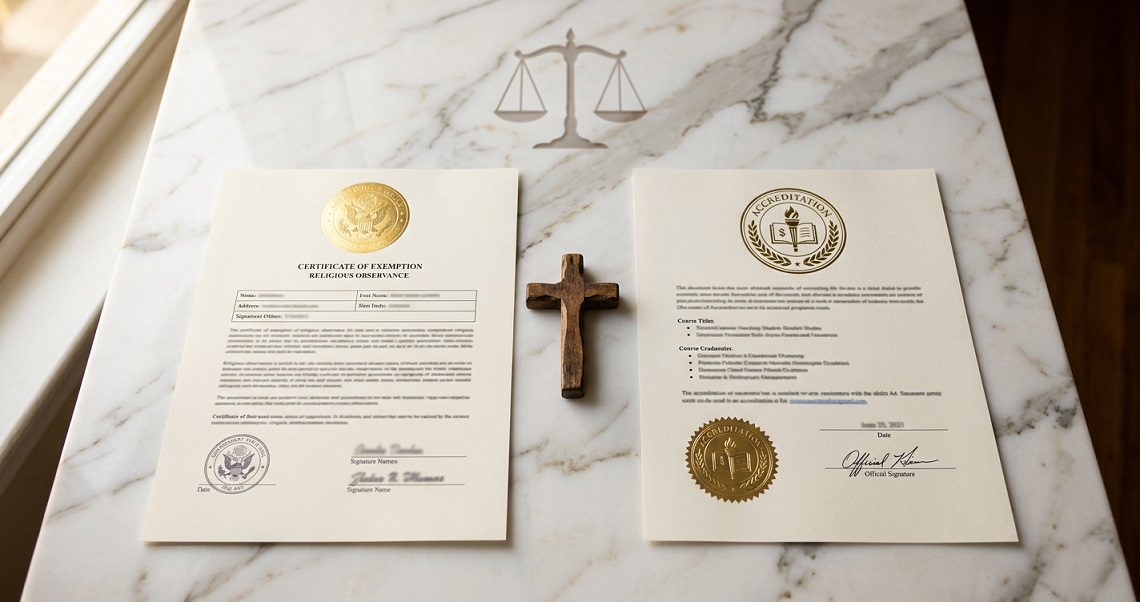
The religious exemption vs accreditation debate is one of the most persistently misunderstood areas of American higher education policy. Critics of faith-based institutions frequently frame the two concepts as mutually exclusive — arguing that an institution operating under religious exemption is by definition unaccredited and therefore illegitimate. This framing misrepresents how both frameworks actually work.
Understanding religious exemption vs accreditation requires treating them as separate but complementary frameworks — each addressing a different aspect of institutional recognition. Our guide to the religious college legal framework USA covers the constitutional foundations in detail — this article focuses specifically on the practical distinction between exemption and accreditation.
What Religious Exemption and Accreditation Each Actually Do
In the religious exemption vs accreditation framework, the two concepts address entirely different institutional needs.
Religious exemption is a legal authorization framework — it defines an institution’s right to operate, issue degrees, and conduct educational activities within its religious mission without the same regulatory requirements imposed on secular institutions. It derives from First Amendment constitutional protections and is implemented through state-level provisions such as Florida’s Annual Verification process for religious colleges administered by the Florida Department of Education.
Accreditation is a quality assurance framework — it defines whether an institution’s academic programs, governance, and operations meet standards set by an independent evaluating body. Accreditation can come from domestic bodies recognized by CHEA, or from international bodies listed in the CHEA International Quality Group directory.
The two operate in parallel — not in competition.
Fact 1 — Religious Exemption vs Accreditation Are Not Mutually Exclusive
The most important fact in the religious exemption vs accreditation discussion is that the two are not mutually exclusive. A faith-based institution can — and many do — hold both religious exemption status at the state level and accreditation from recognized bodies simultaneously.
Religious exemption provides the domestic legal operating framework. Accreditation from bodies such as AUAP and ECLBS — both listed in the CHEA CIQG directory — provides the international quality assurance layer. Institutions combining both present a more complete recognition profile than those relying on either framework alone.
Fact 2 — Religious Exemption Does Not Mean Unregulated
A persistent misconception in the religious exemption vs accreditation debate is that religious exemption removes all regulatory oversight. It does not. Religious exemptions remove specific categories of regulatory burden — particularly those that would interfere with an institution’s religious mission — while leaving consumer protection laws, anti-fraud regulations, and state-level oversight requirements intact.
Florida’s Annual Verification process is itself a form of ongoing state oversight — requiring qualifying institutions to demonstrate continued compliance with religious college operating requirements. This ongoing compliance process is the regulatory mechanism within the religious exemption framework — not its absence.
Fact 3 — Accreditation Does Not Require Abandoning Religious Mission
From the other direction in the religious exemption vs accreditation discussion, holding accreditation from recognized bodies does not require a faith-based institution to abandon or compromise its religious mission. International accrediting bodies such as those listed in the CHEA CIQG directory evaluate institutions against quality standards that are framework-neutral — they do not impose secular values or require institutions to operate outside their religious identity.
Faith-based institutions holding CIQG-listed body accreditation maintain their religious identity and mission while simultaneously meeting internationally recognized quality standards — demonstrating that religious exemption and accreditation are genuinely complementary rather than competing frameworks.
Fact 4 — The Religious Exemption vs Accreditation Distinction Matters for Degree Recognition
In practical terms, the religious exemption vs accreditation distinction affects how degrees from faith-based institutions are recognized in different contexts. Degrees from institutions operating under religious exemption are legally issued credentials within their jurisdiction. Recognition by employers, professional bodies, and other universities depends on those receiving parties’ own policies — just as recognition of any degree depends on context.
For international professionals, the combination of religious exemption status and accreditation from internationally recognized bodies provides the most robust recognition profile. Our guide to honorary doctorates for international professionals addresses how this recognition framework applies to honorary degree recipients specifically.
Fact 5 — Verification Is the Same Regardless of Which Framework an Institution Uses
The correct verification approach in the religious exemption vs accreditation context is the same regardless of which framework an institution primarily operates within. Check state Department of Education records for religious college authorization. Check the CHEA database and CIQG directory for accrediting body recognition. Check government ministry portals for international recognition documentation.
Official databases and government records are the only reliable verification sources — and they cover both the religious exemption and accreditation frameworks comprehensively through publicly accessible, free tools.
Frequently Asked Questions
What is the difference between religious exemption vs accreditation?
Religious exemption is a legal authorization framework allowing faith-based institutions to operate and issue degrees within their religious mission without standard secular accreditation requirements. Accreditation is a quality assurance framework through which independent bodies evaluate institutions against recognized standards. The two are separate and complementary — not mutually exclusive.
Can a faith-based institution hold both religious exemption and accreditation?
Yes. Many faith-based institutions hold religious exemption status at the state level and accreditation from recognized international bodies simultaneously. Combining both provides a more complete and verifiable recognition profile than relying on either framework alone.
Does religious exemption make a university’s degrees illegitimate?
No. Degrees from institutions operating under religious exemption are legally issued credentials within their jurisdiction. Their recognition in specific professional contexts depends on the receiving party’s policies — as with degrees from any institution type.
How do I verify an institution’s status in the religious exemption vs accreditation context?
Check state Department of Education records for religious college authorization, the CHEA CIQG directory for international accrediting body recognition, and relevant government ministry portals for international registration. All sources are free and publicly accessible.
Is religious exemption recognized at the federal level in the USA?
Yes. Religious exemption for higher education institutions derives from First Amendment constitutional protections recognized at the federal level. State-level implementation — such as Florida’s Annual Verification process — operationalizes this federal constitutional framework within specific state jurisdictions.

