



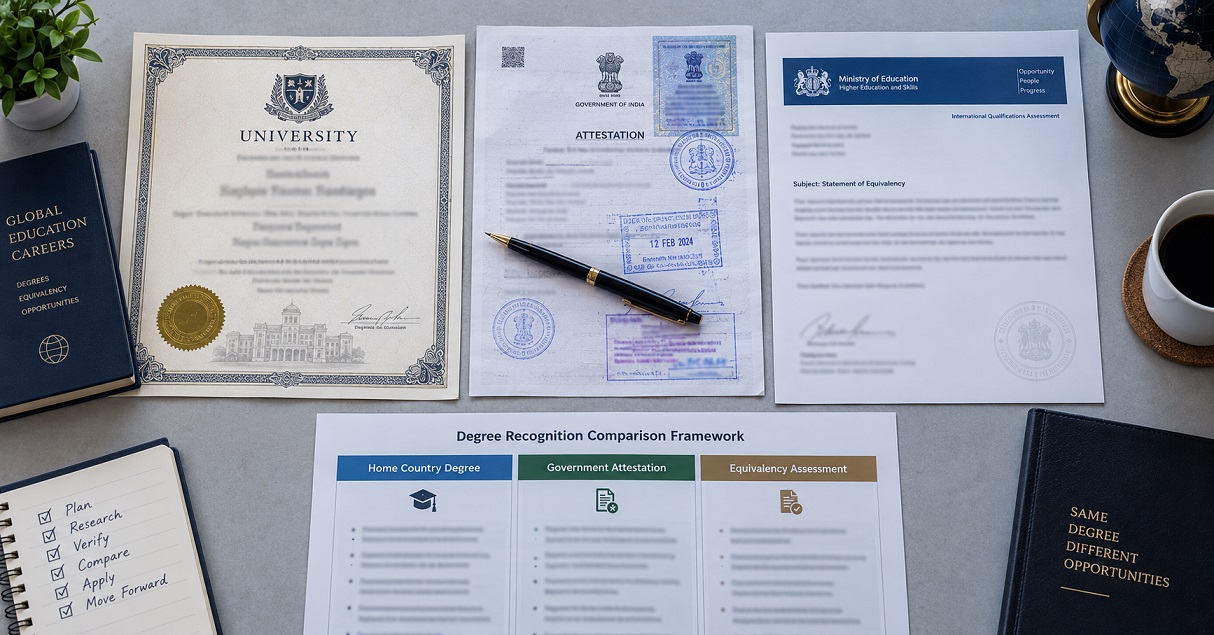
What is qualification recognition — this question is asked by thousands of internationally mobile professionals every year, and most of the answers available online conflate three distinct processes that produce completely different outcomes when confused. Accreditation, attestation, and qualification recognition are three separate steps in the credential verification and acceptance chain. Each has a different evaluating authority, a different assessment methodology, and a different outcome. Understanding the distinction between them is the foundation of accurate credential planning for internationally operating professionals.
What Accreditation Is — And Is Not
What is qualification recognition starts with understanding what it is not — beginning with accreditation. Accreditation is the process by which an accrediting body evaluates an educational institution or program against defined quality standards and confirms that the institution or program meets those standards. Accreditation is evaluated at the institutional or program level — not at the individual credential level.
When a university holds accreditation from a body independently listed in the CHEA International Quality Group directory at chea.org/chea-international-quality-group — this confirms that an internationally recognized quality assurance authority has evaluated the institution against established quality principles. A CHEA CIQG listing provides reference information about an accrediting body’s standing — it should not be interpreted as government recognition by any specific country or a guarantee that a degree will be accepted in any context. It is an institutional quality confirmation — not a national equivalency determination.
Accreditation confirms: the institution has been independently evaluated against quality standards by an accrediting body that is itself referenced in established quality assurance directories. Accreditation does not confirm: that the credential will be accepted for any specific purpose in any specific country.
What Attestation Is — And Is Not
What is qualification recognition — the second distinct step is attestation. Attestation is the process of authenticating the genuineness of educational documents — confirming that the degree certificate, transcripts, and supporting documents are genuine documents issued by the institution named on them. Attestation is a document verification process, not an academic evaluation process.
Attestation is typically required as a prerequisite for qualification recognition processes — you cannot submit fake documents for recognition. But attestation itself confirms only document genuineness — not academic equivalency, not employer acceptance, not professional licensing eligibility. A genuinely attested degree from an unrecognized institution is a genuine document from an unrecognized institution.
For Pakistani professionals: HEC degree attestation authenticates internationally obtained credentials as genuine documents issued by real institutions. This is attestation — document authentication — not qualification recognition (equivalency determination). The distinction matters practically because attestation being granted does not mean the credential has been recognized as equivalent to a Pakistani qualification level.
What Qualification Recognition Actually Is
What is qualification recognition — the third and most complex step. Qualification recognition is the process by which a national government authority or internationally recognized credential evaluation body assesses a foreign qualification and determines its equivalency within the national educational and professional framework. Qualification recognition answers the question: what is the national equivalent of this foreign credential?
Each major destination market has a specific qualification recognition authority and process. UAE: MoHESR — Ministry of Higher Education and Scientific Research — provides Qualification Recognition for internationally obtained credentials through a case-by-case assessment of the credential against the UAE qualifications framework. Canada: WES — World Education Services — at wes.org provides credential evaluation accepted for immigration and many employer contexts. India: AIU — Association of Indian Universities — at aiu.ac.in provides formal equivalency assessments for internationally obtained credentials. Pakistan: HEC — Higher Education Commission — manages both attestation and equivalency assessment for internationally obtained credentials.
For UAE specifically: the correct authority for qualification recognition is MoHESR — Ministry of Higher Education and Scientific Research — not MOHRE which is the Ministry of Human Resources and Emiratization, covering labor and employment regulation rather than educational qualification recognition. This is the most consistently confused distinction in online discussions about UAE credential acceptance.
The Three Steps in Sequence
What is qualification recognition — understood correctly — is Step 3 in a three-step credential verification chain:
Step 1 — Accreditation: Does the institution have verifiable quality assurance standing? Verified through: state government authorization at fldoe.org for Florida institutions, accrediting body references in CHEA CIQG, and additional governmental documentation layers.
Step 2 — Attestation: Are the credential documents genuine? Verified through: the relevant national attestation authority — HEC for Pakistan, equivalents in other markets.
Step 3 — Qualification Recognition: What is the national equivalent of this credential? Assessed through: MoHESR for UAE, WES for Canada, AIU for India, HEC equivalency assessment for Pakistan.
Each step is necessary. No step substitutes for another. Strong accreditation standing supports qualification recognition by providing the documentation of institutional quality that recognition authorities assess — but accreditation does not produce recognition automatically. Recognition is always a separate case-by-case determination by the national authority.
What Qualification Recognition Confirms — and Does Not Confirm
What is qualification recognition also requires understanding its precise scope. Qualification recognition confirms: the assessed credential is equivalent to a specific level within the national qualifications framework of the assessing country. It does not confirm: automatic employer acceptance in that country, automatic professional licensing eligibility, or recognition in any other country.
A MoHESR Qualification Recognition outcome of “equivalent to UAE Master’s level” means the credential has been assessed as academically equivalent to a UAE Master’s qualification — it does not mean every UAE employer is required to treat it as such, or that it automatically satisfies any specific professional licensing requirement. Individual employers and professional regulatory bodies make those determinations.
For the complete verification framework covering institutional quality standing — our guide to accreditation bodies for online degrees covers all four verification categories. For how to read any institution’s website to understand its accreditation profile before enrolling — our guide to how to read a university website before enrolling covers the complete 7-check methodology.
Frequently Asked Questions
What is the difference between accreditation and qualification recognition?
Accreditation evaluates an institution or program against quality standards — confirming institutional quality standing. Qualification recognition evaluates an individual credential against a national qualifications framework — determining national equivalency. Accreditation is institutional. Qualification recognition is credential-specific and country-specific. Strong accreditation supports qualification recognition applications but does not produce recognition automatically.
What is the difference between attestation and recognition?
Attestation authenticates a document’s genuineness —confirming that credentials are real documents from real institutions. Recognition determines national equivalency — assessing what the credential is equivalent to within a specific national framework. Attestation is typically required before recognition but does not substitute for it.
What is MoHESR qualification recognition in UAE?
MoHESR — Ministry of Higher Education and Scientific Research — provides case-by-case qualification recognition for internationally obtained credentials in the UAE. The assessment evaluates the credential’s equivalency against the UAE qualifications framework. MoHESR is the correct authority for educational qualification recognition — not MOHRE, which covers labor and employment regulation.
How do I get my foreign degree recognized?
The process varies by target country: UAE — apply through MoHESR. Canada — apply through WES at wes.org. India — apply through AIU at aiu.ac.in. Pakistan — apply through HEC. Each process requires documentation of the awarding institution’s domestic authorization and academic standing. Assembling complete institutional documentation — including government authorization records and accrediting body references — before applying supports the recognition process.
Does CHEA CIQG listing mean a degree is recognized in any country?
No — CHEA CIQG listing provides reference information about an accrediting body’s standing. It should not be interpreted as government recognition by any specific country or a guarantee that a degree will be accepted in any context. Each country’s recognition authority—MoHESR, WES, AIU, HEC— determines qualification recognition separately through its own case-by-case assessment process.


